Tuesday, 25 March 2014

THE RANK STENCH OF THOSE BODIES

Detail of Charles Sergeant Jagger's "No Man's Land"
At the beginning of November 2012 I had the opportunity to attend the celebration of Remembrance Day at the English Cemetery in Malaga, the oldest non-Roman Catholic Christian cemetery in mainland Spain, and I must say it was an impressive experience to stand in silence in the middle of the tombs covered with little white crosses and wreaths made with poppies. Not many Spanish people know about this tradition, which has its origin in the very end of World War I. The hostilities ended “at the 11th hour of the 11th day of the 11th month” of 1918. Since 1919, a two-minute silence is held in Britain to pay homage to those who died in that war and in subsequent conflicts. People also wear poppies in their lapels, a tradition that has its origin in the poppies that bloomed in the battlefields and the poem that John McCrae dedicated to them, “In Flanders Fields”. 


This year commemorates the centenary of the outbreak of World War I, a tragedy that shaped the future of Modern Britain. Contrary to other historical events, the spirit of this war is still alive and tangible in this country, something that took me by surprise, as I hardly remembered the list of dates and battles I had been fed in high school: le Somme, Ypres, Gallipoli, Passchendaele…

World War I started to take shape in my conscience as something real, lived by real people, when I read this passage in Andrew Marr’s “The Making of Modern Britain”, a description of the salient of Ypres by a journalist, Philip Gibbs:

“a sea of red liquid mud composed of brick dust and bodies, bits of bodies, and clots of blood, and green metallic-looking slime, made by explosive gasses... Human flesh, rotting and stinking, mere pulp, was pasted into the mud-banks. If they dug to get deeper cover, their shovels went into the softness of dead bodies who had been their comrades. Scraps of flesh, booted legs, blackened hands, eyeless heads, came falling over them when the enemy trench-mortared their position.”

I would like to illustrate this passage with a work by Charles Sargeant Jagger,   a bronze frieze titled “No Man’s Land” which shows a man hiding among the corpses of his comrades. You can find it at the Tate Britain.


Then I watched the magnificent series of documentaries by Jeremy Paxman “Britain’s Great War”, which gave me a new and more human insight of this conflict: the memory of being shelled by German boats in the middle of the night shared by a one hundred and five year old lady who survived the Hartlepool raid at the age of seven; the posters of Kitcheners’ appeal for volunteers that managed to recruit two and a half million men for the British army; the doctor from New Zealand who restored the facial injuries of disfigured soldiers and created the basis for modern plastic surgery in a hospital in Sidcup, a short bus ride from where I live; how Britain managed to face the shortage of manpower by involving women into the war effort and how many of these women died of poisoning working in munitions; the first conscientious objectors and the increasing gap between those who fought the war and those who sent them to the trenches…

Let’s take a short walk around Central London and find the traces the first modern conflict has left in this city.


Our journey begins at the Cenotaph in Whitehall. It’s a key landmark in the commemoration of the dead in the wars since 1919. On the Sunday nearest to the 11th November a service is held, which is attended by the Queen, religious leaders, politicians, and representatives of the armed and auxiliary forces. The poppy wreaths that are deposited at the base of this monument can still be seen months afterwards. The BBC has a very interesting history section about World War I and there I learned that this monument, whose name means “empty tomb” in Greek, was originally built in wood and plaster, as it was intended to be used only at the 1919 Armistice Celebrations, but it became so popular that they had to build a permanent one in 1920.


Today is a lovely day that announces the end of winter and the street is full of colourful characters, like this group of men dressed like ludo counters. 
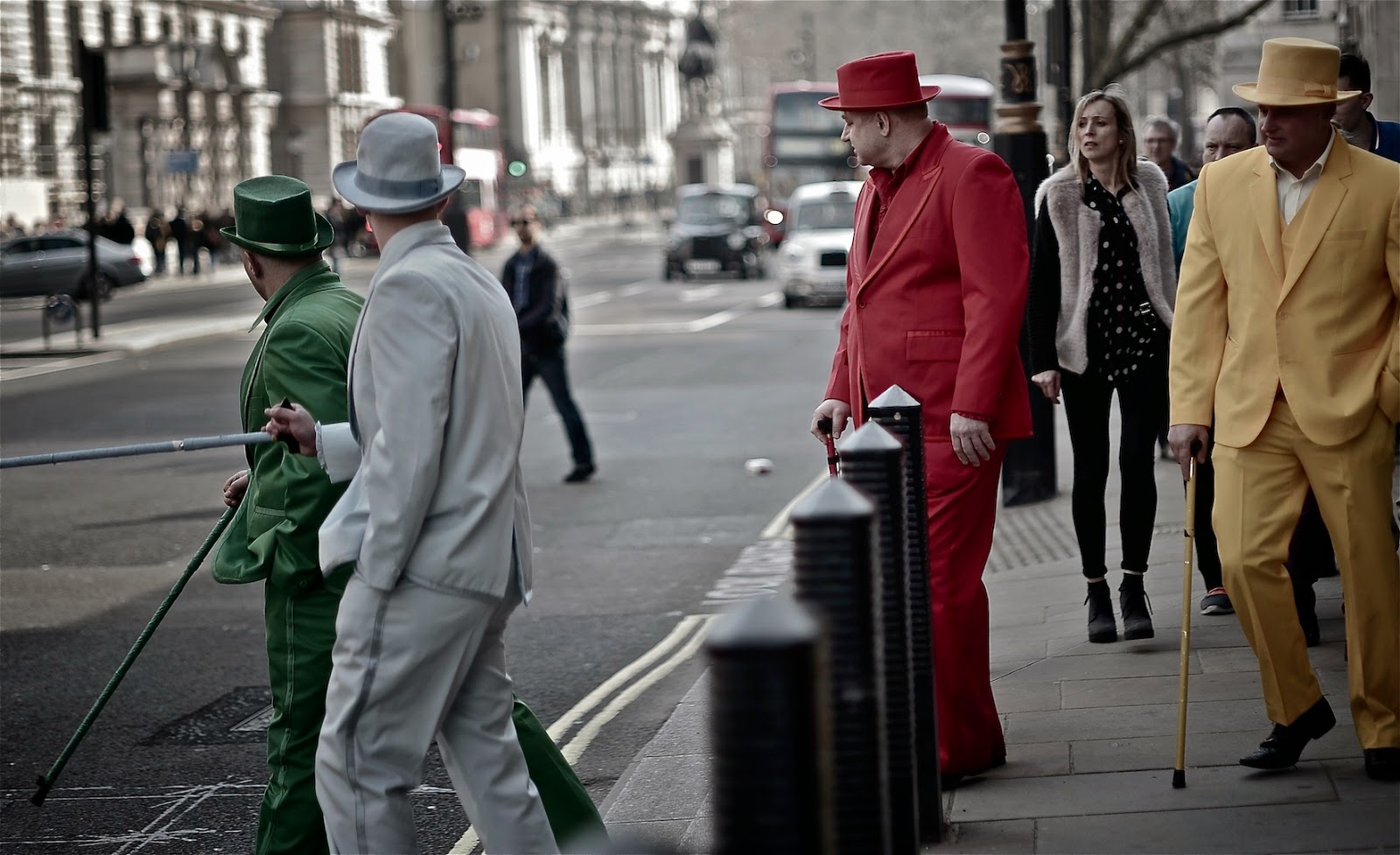

However, as we walk up towards Trafalgar Square, we are reminded of conflict once again. 


Not very far from the statue of Field Marshall Douglas Haig, whose strategy led to the death of so many in the Western Front, we can see a group of demonstrators trying to draw attention to the situation in Venezuela. 


Next to them there is another group of protestors against the invasion of Ucraine by Russian troops. Our walk cannot be more meaningful today.


Trafalgar square is the next point in our pilgrimage. If you had been here one hundred years ago, you would have seen placards encouraging people to buy war bonds. You would even have seen a tank, one of the main technological advances in British warfare, parked in the middle of the square. And if you had been here during the celebrations after the Armistice, you would have seen the Australian and Canadian troops making a bonfire with these placards. In the final documentary of his series, Jeremy Paxman shows a stone under Nelson’s column where you can still see the effects of this act of patriotic vandalism.


Our next stop is the National Portrait Gallery, where there is a very recommendable exhibition, “The Great War in Portraits”, which allows us to put faces to those who led and fought this war. What impressed me the most was the opening sculpture, Jacob Epstein’s “The Rock Drill”, and a wall covered with a collection of portraits of people involved in the war, famous and anonymous, allies and enemies, men and women. You can read the story behind these faces in a booklet that is provided in the gallery. 


This exhibition will be open to the public until 15th June 2014. Whether you are planning to come to London soon or not, even if you have already been to this exhibition, it’s worth listening to the curator’s guided tour: http://www.npg.org.uk/whatson/firstworldwarcentenary/curator-tour.php


I have already mentioned Charles Sargeant Jagger. If we carry on walking towards Hyde Park Corner, we will find one of his most famous works: the “Royal Artillery Memorial”, which shows four figures: a driver, an artillery captain, a shell carrier and a dead soldier covered by his own coat. The driver is wearing a cape that is being blown by the wind and when I look at him I often have the feeling of looking at the figure of an angel with its wings extended.


The next stop leads us to the other side of the park, in Marble Arch, where you can visit a monument that pays homage to all the animals that lost their lives in wars. Their role was key in the trenches: pigeons that carried messages, mules used to transport armament and munitions, war horses... Again, I remember a passage from “The Making of Modern Britain” where Andrew Marr describes some of the terrible conditions these animals lived in: mules who had their vocal chords cut for fear that their braying gave away the soldiers’ position, horses who were painted in black for the same reason... On this monument you can read the inscription “They had no choice”.


Our walk ends at the Marquis of Granby, a pub you can find behind Millbank, next to the river Thames. Here there is a corner devoted to one of the most fascinating heroes of this war: the poet Siegfried Sassoon. He was sent to the front in France, was injured and won the Military Cross. However, he decided to throw it into the Mersey estuary and stand against a war he felt pointless. His poetry describes the horrors of this war and denounces the gap between those who fought it and the callous politicians who made the decisions at home. Eventually, Sassoon decided to go back to the front in order not to abandon his comrades and was wounded again. In this corner you can find some photos, together with some original copies of his work.


I would like to finish this entry with an extract of one of Sassoon’s poems, “The rank stench of those bodies haunts me still”:
“To-night I smell the battle; miles away

Gun-thunder leaps and thuds along the ridge;
The spouting shells dig pits in fields of death,

And wounded men, are moaning in the woods.”


APPENDIX

If you want to find out more about this engaging topic, visit the BBC history website: http://www.bbc.co.uk/ww1
And finally, if you want to check how much you know about this event, I invite you to do this quiz: http://www.theguardian.com/commentisfree/quiz/2013/jun/11/quiz-first-world-war

I managed to score 7 points. What about you?

Photo: Lorenzo Hernandez                                            www.photolorenzohernandez.com


Sunday, 2 March 2014

A TIME CAPSULE FOR THE FUTURE GENERATIONS


A wedding album can be a powerfully evocative object. I remember the fascination I felt as I passed the tracing paper pages that protected the old black and white photographs of my parents’. Every time I opened the album it was as if I saw it for the first time: my mum wearing the wonderful silk dress my grandma had made for her, my father thin and without the moustache that would become one of his most defining features, the magnificence of the cathedral... I remember the covers were made of dark green leather and the pages inside, black and thick like cardboard.

A few months ago we celebrated a reminiscence session devoted to weddings in Camden. Shirley, one of the ladies in the group, brought a very similar album, but this time the photos showed a traditional Jewish wedding. However, the album had the same leather cover and black pages and the photos were also protected by tracing paper. Leafing through Shirley’s album I experimented the same kind of feeling, and I could also observe that she lit up explaining the different details of the images.

This is something that could be said of all the wedding photos of the time. Anita Berlin showed me a photo of her parents, Ludwig and Carmen, outside the registry office and they reminded me of the glamour of La Dolce Vita. Another good example is Fay and Tom’s wedding photos, full of the swing of the 1960s, which you can see at the top of this page.

Nowadays the feeling is almost gone; there is a lack of soul in the wedding albums, once you have seen one, you rarely feel like going through it again. It might have something to do with the fact that we are overexposed to images and by the time you see the album you have already seen the same shots one hundred times on your friends’ facebook accounts. But I am convinced it is also the professional photographers’ fault, as they fail to face the challenge of offering something truly original, something that cannot have been taken by anybody’s mobile phone camera.

The format has also something to do with this: there are photographers that cut down costs by offering just a CD with all the photos; others offer digital albums with a metallic touch; and sometimes they use digital retouching so much that the groom’s mother could be taken for the bride’s little sister. Also, the photo selection fails; often it’s the couple who do this job and as a result there is no rhythm, no story. It’s not their fault, but editing is one of the most important and difficult parts of a photographic job and it should be done by a professional. Would you handle the scalpel if you had to undergo surgery? Well, this is what people seem to do when it comes to wedding photography.


A wedding album is something that should be timeless, that should trigger memory rather than giving you the whole story (videos are meant for this, and people rarely watch a wedding video more than once). An album is an object that is not meant for the couple who order it but for their future selves and the future generations.

Lorenzo does not take many wedding assignments; most of them come to him through word-to-mouth and he sometimes documents several weddings and other events within the same family. He has a very clear idea of what a wedding album should be, a witness of the couple’s life around the time they got married: their jobs, their friends, their hobbies. With this aim in mind, he meets them several times along the year. We’ve had photo shootings in primary schools, fire stations, onion warehouses... even in the couple’s bed. We also include friends and family. The result is an album in which you can feel the soul of the people portrayed; you can see who they are, and in the future their children will see who they were.


This is a concept that we share with Juan and Sonia, who came to London last week especially for a photo shooting that will be part of their wedding album. They are getting married at the end of September and we started our project last July. We’ve had several shootings since then, involving the two of them and their two little children, Juanito and Sonia, who are going to play an essential role in the event. While having a drink on the beach after one of these shootings, we suggested that they could come do the next one in London. So they decided to come here during the half-term holidays in February instead of going to Lisbon, as it was their original plan.


We met them in front of the Big Ben and spent the day in the South Bank. At the beginning, it was a bit hard because if you look at Lorenzo’s photos, you’ll realise he has a thing for introducing an element of movement and he often uses birds for this purpose. Well, there were plenty of seagulls and birds on the riverbank, but they refused to fly on the right direction, so Juan and Sonia had to wait patiently while I tried to attract or shoo the birds away. Luckily, Lorenzo is a specialist in catching the moment.


We spent the rest of the day making the most of the wonderful locations in the area: the Undercroft, the National Theatre, the Tate Modern, the Millennium Bridge... But my favourite place is by far the beach you can find in the riverbank when the tide is low. There you can see the rests of London’s medieval past, which is hidden almost everywhere else. Going down the stairs that lead to this beach is like stepping back in time and the magic in the atmosphere is undeniable. Here is where Lorenzo took some of the best pictures of the couple.


To finish the day, Juan suggested that we drink a pint of Nicholson’s at the Blackfriar, a cosy pub situated under the bridge of the same name. It was just what we needed after a long day of work, almost eight hours.

I don’t know how to define Lorenzo’s wedding albums; they contain elements of fashion and street photography and when you look at them you can really feel love and positivity. Something that confirms that we are doing the right thing is what Sonia told us at the end of the day: she caught their five-year-old son taking pictures of his toys
 and when she asked him what he was doing, he said: “I am taking pictures like Lorenzo.”


Photos making of: Marta Moreno                         www.photolorenzohernandez.com

Sunday, 9 February 2014

THE BEVIN BOY AND THE SMOKING POTS IN THE OLD BREWERY

Fay and Tom met while they were working at Truman’s Brewery in Brick Lane in the nineteen sixties, when Truman was the last major independent brewery in London. They have been together since then. 


Tom was one of the Bevin boys during the Second World War. The Bevin boys were young men who were conscripted to work in the coalmines. The programme was named after Ernest Bevin, the Minister of Labour and National Service in the wartime coalition government. The work conditions could be as terrible as being in the front, but contrary to what happened to soldiers, nobody recognised their contribution to victory until 1995. In 2007 the British Government decided that these men would receive a Veterans Badge. Tom received his recently and now he wears it proudly on his lapel.


Fay is a very lively woman who sings, dances and performs. She’s also got a great sense of humour. Fay showed me their wedding photo; the smile on her face is unmistakable: Tom was the man of her life. Here you can see these images, together with a poem she wrote herself a few months ago, which ends with these wise words:

“Baby, childhood, teenage years
                                      all gone
   30, 40, 50, 60 70 years, will I
                                      carry on?
                  Bet your life I will.”


If Fay and Tom haven’t changed so much, the brick building which used to be the site of this famous brewery can’t be more different. Truman closed in 1989, but the Eagle that was the symbol of the company is still up there, looking at the groups of young people, tourists and street artists that fill the area every Sunday afternoon. The brewing machinery is not there anymore and the place has been taken over by an exciting street market. 


When you arrive at Brick Lane all your senses become alert. First, you hear the siren songs of the owners of the curry houses that line the street, trying to attract prospective clients by offering them an incomparable culinary experience for only ten pounds. Then, as you approach the brewery, the smell of spices and exotic dishes fills your nostrils. And as you enter the old building, you can feel the heat of the boiling pots in the stalls. All the world cuisine is represented here: Turkish, Vietnamese, Greek, Thai, Japanese, Italian, Spanish, Lithuanian, you name it. 
And all of a sudden you are starving, longing to buy some vegetable stew with noodles or perhaps a combined Turkish plate. It’s hard to choose and you tell to yourself that you will return next Sunday to try what you couldn’t eat today. Everybody here is carrying a tin foil little tray or a paper plate, eating and talking and laughing.


This is a good opportunity to have a conversation with some of the cooks, like a couple of Italians who are about to open their own restaurant in London and who make a mean lasagna, just like the one that la mamma cooks back in Rome. 


Now it’s time to walk around and look at the people who fill the market. The mixture of cultures and races is everywhere, which is one of the beauties of this city. The atmosphere is friendly and relaxed.


I decide to stop at a small stall that sells old spectacles and I try on a few. Some of them are really beautiful, like a butterfly frame from the 1950s, but they look fragile and I have to wear very expensive lenses, so getting them is out of the question. A couple of Spanish girls stop next to me and start taking selfies wearing different glasses, ignoring the notice that asks people not to do so. The person in charge tells them something about it, but they just say “Thank you” and ignore what she has said. I pretend to be Russian.

Lorenzo, who has been walking around taking photos, joins me and we walk to a stall that sells second hand clothes. There is a wonderful green leather jacket for ten pounds, which he buys. Carla is looking for a dress for a party.


We leave the brewery and walk round the corner into Rough Trade Records. This is a paradise for me. I put on a pair of headphones and listen to the CDs on display. I write down some names to check out later, like an atmospheric song called Hey Now by a band called London Grammar. As I listen to the music I look at the walls of this shop, covered with old concert flyers. There is also a book section with places to seat and leaf through, another beauty of London (you can do this in most bookshops, something that makes you  feel  really grateful on a rainy day).


We end up drinking some coffee at cafe 1001, which has a different DJ in each room, and finish the day with a short walk. This will bring more surprises, like a man playing a ragtime tune in an old piano in a junk shop.


It’s dark and we walk back to the DLR station. Another dark Sunday evening in London, as dark as the coalmine galleries of the Bevin boys.


Photos: Lorenzo Hernandez                                                          www.photolorenzohernandez.com

Sunday, 19 January 2014

GRANDMA PAQUITA AND THE WONDROUS LIFE PATTERN

Grandma Paquita at the age of 14


Lives are lines that criss-cross time and space; sometimes these lines meet serendipitously, sometimes they run along parallel lines that are never meant to converge. However, if we could observe these lines from above, we would marvel at the beautiful pattern they make.

View from the Tate Modern Members Room


Let’s take two moments separated by one thousand miles and nearly twenty years in time. In the first one there are two women sitting at the Tate Modern Members Room contemplating how the weak November sun sets behind St. Paul’s Cathedral. One of them is pregnant, but the baby is not the topic of their conversation. They are talking about the history behind her family, who left Indonesia after the independence war that followed the Second World War. It’s the most engaging story: a beautiful Indonesian woman had two daughters: the first one with a Dutchman and, ten years later, the second one with an Indonesian man. When the colonists decided to leave the country, the ‘pure’ ethnic Indonesians took revenge on those who were descended from the Dutch, because they had enjoyed privileges which they never had. Many people who had just returned from the terrible Japanese prison camps were interned again in Indonesia, especially those of Dutch descent. The government of the mother country made a decision: the Dutch descendents would be invited to move to Holland. However, the Indonesians would have to stay, however harsh their plight. This separated the two sisters for life.


In the second moment, the woman who was listening to the story is eighteen years younger. She is in the South of Spain, in her hometown, and she’s visiting her grandmother, who is very ill. The old lady lives with her youngest daughter, who is married to a Dutchman. All of a sudden, she looks restless, and asks her granddaughter to come nearer and whispers in her ear: “My darling, as you like travelling so much, I’m sure you’ll be able to lend me a suitcase. I am going to the USA.” The young woman thinks that her grandma is speaking nonsense, that this request is just another symptom of the dementia that has been taking hold of her life during the last months. She promises that she will bring her the suitcase, being sure that she will have forgotten by the end of the day. This day the young woman’s life will change forever, but I won’t tell you about this. Yet.


The two moments are connected because there are two parallel stories, the story of two sisters who were separated for life but stayed linked by an invisible thread. The first woman in the story is my friend the painter Marenka Gabeler. I am the second one. This is the story I told her that evening in the Tate Modern.

Grandma Paquita as a young girl


In every family there is someone who is the guardian of the stories, who keeps them and who transmits them to the new generations. In my family, it’s my mother, Paquita. She says it’s important to tell the children where they come from. When we were kids, she used to tell me “adventures” instead of fairy tales. The protagonists of these adventures were always members of the family: there was the one about how my uncle Juan Manuel ran away from the seminary several times (how my grandma thought he could become a priest is a mystery to me), the day my mum took a sun ray for the Virgin Mary, how la tata María cut the chickens’ necks and they started to run about headless... The stories went back generations until the middle of the nineteenth century, when my grandmother’s grandfather, a Frenchman, came to the South of Spain with Empress Eugenia de Montijo. This man spent all his fortune on gambling and having a good time, so there was no money left for the next generation, who had to earn their living as labourers. In fact, his son, my great-grandfather, worked in the building of the famous King’s Path which goes around El Chorro reservoir. Life was hard, my grandmother, another Paquita, was the oldest of twelve children of whom only five survived. My mum always said that the sadness of seeing so many of her brothers and sisters die in their infancy never left her.

My grandparents and their children. My mum is the one on the left.


A very important person in my grandmother’s childhood was her cousin Francis. They were like sisters, as Francis was growing up without her parents. Her mother was dead and her dad had emigrated to America. My mum told me that her grandparents almost did the same but when my great-grandmother, who was holding my grandma Paquita in her arms, saw the ship, she told her husband: “I don’t know about you, but I’m not travelling on that shell”; so all the family decided to stay.

One day, when the two girls were thirteen, Francis’s father returned from America as a rich man. I can imagine the shock of meeting a father you had never seen since you were a toddler. He suggested that he could take his daughter to Malaga to buy her some new dresses. The village where they lived is only twenty minutes’ drive nowadays, but then it took more than a day to get to the capital. So off they went, and they never saw Francis again. Her father put her on a boat and they sailed to America. Cruelty? Certainly. It was a great blow for my grandmother to lose her cousin. But with hindsight, it wasn’t such a bad thing for Francis to be taken to America: she went to the best schools, married a millionaire, had a good life. Paquita, on the other hand, went through the civil war and the post-war years in a country that was in ruins and, without international help, did not start to recover until the 1960s. On the bright side, all her six children survived, including my mum, who was always ill and spent months in bed during her infancy. According to what my mum says and as far as I remember, my grandma had a perennial smile on her face, which was one of her charms.
Grandma and her sisters. She's the smiley one on the left.


Despite the distance, Francis and Paquita kept in touch. She even visited Spain in 1942 with her husband, as you can see in this photo. She also sent parcels to her family, and this is how my mum received nice clothes and nylon stockings. But she did not return until both of them were old ladies in their late seventies, when following the American tradition, she decided to spend a holiday in the place she came from. I was living abroad then, so I never met her. My aunt Cristina says that her English was exquisite but she spoke Spanish with the broad accent of her village, which was very funny, considering she was such an elegant lady.

The two cousins reunite in 1942. Francis' American husband is on the left.

So this brings me back to that evening almost twenty years ago, when my grandma wanted to make the reverse journey and go to the USA to visit her cousin. One week later my auntie told me that she had received a phone call from America: Francis had died on the same evening Paquita had asked me for the suitcase. I don’t know if she somehow sensed her cousin was dying but the coincidence is intriguing nonetheless. 

Paquita died two months later on 31st december 1996.

Grandma with her two youngest daughters: Marilo (left) and Mª Carmen (right).


Marenka’s grandmother refused to go back to Indonesia. The two sisters reunited for the first time in the ninety-seventies. Marenka told me that her great-auntie had the power of seeing people’s spirits; my grandma certainly had a connection with her cousin’s soul.

And how did my life change on that day? After leaving my grandma’s house, I went out for the first time with a man I barely knew. My husband.

(Click here to see Marenka's project on her grandmother and her sister: Sister project And here to see a photo of them published in Marenka's website: photo)