Saturday, 30 November 2013

NOZOMU SEKINE, DARREN GORMLEY AND THE VICTORIA & ALBERT MUSEUM


One of the most amazing persons I have ever met was a Japanese gentleman called Nozomu Sekine. We were both studying French at the EOI Malaga when we met. Every year he spent eleven months in Spain, where he studied and travelled. During the other month, usually in spring, he travelled to Japan to visit his family. We used to sit together in class, revise our homework and soon we became friends. I introduced him to Carla and Lorenzo, who made his portrait. When his wife visited him in Malaga, they came over for dinner. It was one of the most enriching multicultural experiences I have ever had, guided by our friends Luis and Noriko.

One day, I asked Nozomu, who was approaching the age of eighty: Don’t you miss your family in Japan, your wife, your children and grandchildren? He said: Yes, but I have so much to learn


Darren Gormley is not thirty yet, but he has the same kind of spirit and I can perfectly imagine him saying the same in fifty years’ time. He works visiting people with dementia at their homes, on a one-to-one basis. His approach is personal: he does something different with every person; sometimes it’s a weekly game of backgammon or scrabble, others he just helps them with their daily tasks. Often, he accompanies them to museums, concerts and other types of events. And mainly he listens and listens and listens, because the people he visits are wise and have a lot to share. When I started working on this, six years ago, I had no experience of culture. Now I am a completely different person. Thanks to the people I visit (professors, musicians...) I started visiting museums, going to exhibitions... Now if people say that I have interests, it’s because of them.


He also writes a blog, Making Dementia Care Personal www.darrengormley.co.uk which is daring, brave and open. He writes about topics such as gender roles in the caring profession, dementia unfriendly communities, or the stigma of depression. He has also invited contributors such as Sally Knocker, who has written about dementia from the perspective of gay, lesbian, bisexual or transgender persons. When he started the blog last April, he did it on his own time, working in a sector that is not convinced about the idea, as if there was a contradiction between the profession and the public nature of a blog or social networks like Twitter. But he feels the opposite: a great percentage of the people who live with dementia stay at home and what happens in their lives remains unknown. What he’s doing is bringing the issues that arise in his daily work into the open and raising people’s awareness.
It was risky, but fortunately his effort has been recognized and Darren has been awarded two Older People Media Awards. When I heard my name, I felt actually sick. I never thought I was going to win. Then I was there, posing with the awards and the only thing I wanted to do was to go and show it to the people I am visiting. They were delighted and proud of Darren. They even wanted to have their photo taken with the awards. That was definitely the best moment.


Darren’s career choice was determined by the close connection he had with his grandparents when he was a kid. In that time, he used to take the bus to visit them and felt really grown up when travelling alone. When we took number eleven to go to the V & A museum, he told us that his favourite buses are those that replicate the old models with the open door at the back. From those trips he remembers that there was a conductor who sold the tickets and used to sing out loud all along the journeys.


Once we arrived at the museum, his favourite place in London, we walked around the sculpture gallery and then sat at the wonderful cafeteria, decorated with gorgeous stained glass windows and gigantic globe-like lamps. Here you can taste one of the best café latte in the city.


Darren took out his computer and showed as a video of him jumping off a plane with the purpose of raisin money to help people with dementia in Kensington and Chelsea. He’s also going to run for Alzheimer’s Scotland in next year’s Edinburgh Marathon. He has chosen this organization for the breakthrough work they are doing. There’s another Scottish connection: he did his MA on Dementia Studies in Sterling.

We finished the day at Battersea Park’s athletics track, where Lorenzo photographed him training with the shirt he’s going to wear at the marathon.


Talking to Darren is enriching and engaging. He’s a great listener and he has a lot to say.


Which brings me back to my dearest friend Nozomu. A few weeks ago, when I stated the blog, we sent him a link to Tokyo, where he moved back right before his eightieth birthday. Some days later we received the saddest news from his daughter Makiko: he passed away this May. She told us that he often wore the scarf we gave him during his last winter. I still can’t believe it. In my mind Nozomu would live to one hundred. He still had so much to learn.

Photo: Lorenzo Hernandez                                                                www.photolorenzohernandez.com

Monday, 18 November 2013

THE MUDDY BEAUTY OF THE THAMES


One of the really good things about the Reminiscence Group is that you have the opportunity to discover new things about London through the eyes of its dwellers. For example, last Monday Ted brought me a newspaper cutting of an article by Will Self. The famous writer talked about his lifelong obsession with the Thames, which had led him to walk on the foreshore of the river until he found himself immersed thigh-deep in the muddy water. What Ted suggested was not so extreme: there is a Thames path you can take along the river, from Monument to the Isle of Dogs on the northern shore and from Greenwich to London Bridge in the south.

Living so near Greenwich, we had already experienced the lively activity on the river. In fact, not so many weeks ago, Pam and I discovered a very ancient boat, one hundred years older than the Cutty Sark, anchored in front of the Royal Naval College. It was going to stay there for three days before being towed all the way to Australia. Also, when you walk along the river at night, you can see the lights of the boats that cross it and, on a sunny day, you can choose to travel to Central London by boat instead of taking the underground.
So taking a long walk along the river seemed like a good opportunity to see London from a new perspective, and this is what Lorenzo and I decided to do last Sunday, following Ted’s advice.

We opted to walk along the south bank from Greenwich to London Bridge. I must say that the experience was quite disappointing. We started following the riverbank, but soon were diverted inland and we stopped seeing the water. There were signals that read “Thames Path”, but they just took us along streets full of ugly buildings, and whenever we got to the river, the sights were pretty depressing. So, we decided to return to Greenwich and cross the underwater tunnel that leads to the Isle of Dogs.


This 70-metre foot tunnel was built in 1902 and is now being repaired, although you can still use it. It’s quite an experience, especially if you are a little bit claustrophobic, because you can’t avoid thinking that you are under the river. I used to cross this tunnel a lot when I lived in London twenty years ago, and it hasn’t changed so much. The only difference is that now we can use the original lifts, which were being repaired in 1992, so I had to go up and down the long spiral staircase every time I wanted to visit Greenwich market.


Once you get to the Isle of Dogs, you can see in front of you the Canary Wharf building, one of the landmarks of the Docklands area. If you turn towards the river in Island Gardens, the views are impressive: you can see the Royal Naval College and, to the left, the old power station with its four majestic chimneys. 


We decided to walk eastwards and reach the Thames Barriers. Here the path follows the river almost constantly and you can see old and newly renovated buildings with a view to the river. It’s a really pleasant walk where you can meet people with their dogs or riding their bikes. 


From time to time you can reach a concrete slipway full of pebbles and moss that leads to the muddy shore. Every time a boat goes past, the waves lap the concrete and you must be careful not to get your feet wet. 


As you walk, you can see new landmarks on the opposite bank, like the huge dome of the O2 Arena.


Eventually, the path took us back to the road and, to our surprise, we saw the Canary Wharf in front of us again.


We had not realized that the Thames meanders around the isle, so we had almost returned to the starting point. Then we realized that the Barriers might not be as near as we thought. Fortunately, there are nice pubs along the way where you can stop for a pint and have a rest.

We decided to go on and eventually we reached the futuristic-looking barriers.


The first time we learned about their existence was ten years ago, when London was bidding for the Olympics and we saw an advert in the underground that showed some swimmers posing as if they were about to jump from the barriers into the river. Since that moment, they stayed at the back of our minds.


These amazing works of engineering were built in the 1970s with the purpose of controlling the floods of the river. Jason, the caretaker of the university building in Woolwich, told Lorenzo that he used to swim from one barrier to the other when he was a kid, which is something he wouldn’t recommend now. Looking at the barriers you have the feeling of having been teleported in time and space; they would fit perfectly into the sets of Mad Max or Planet of the Apes.


Once you pass this part of the river, you can take the ferry that takes you to Woolwich, in the south bank. From there you can take the bus back to Greenwich.
The day was cold and grey but the light was perfect to enhance the beauty of the Thames.

Photos: Lorenzo Hernandez                                                         www.photolorenzohernandez.com


Saturday, 9 November 2013

REMINISCENCE TRAINING: A CELEBRATION OF MEMORIES


Every Monday I participate in a reminiscence group in North London. It’s part of my apprenticeship, which began with a two-day course as soon as I arrived at the end of September. Pam was kind enough to offer me a place in this scheme, and she also invited Lorenzo to participate.


The students who took part in this course came from the most diverse backgrounds but had a common interest in reminiscence. Some had ample experience in social work; for example, Kate Moffatt, Julia Statman and Darren Gormley work visiting people with dementia who live alone. Kate told me it’s difficult to imagine how many lonely people live in this city, some of them for not having children, others for having their relatives too far away. Others use art as a way or reaching to people: Reena Clare, a sweet girl from Malaysia, uses her amazing drawing skills to illustrate people’s memories and Jo McCauley, who comes from Donegal,  uses music to awaken reminiscence. There were other artists, like Australian documentary maker and storyteller Dvora Liberman or Dutch painter Marenka Gabeler. Marenka has a very special relationship with the preservation of memory, as she’s making a project based on her dear grandma, who suffers from Alzheimer’s and lives in Holland.

I’d recommend you to visit Marenka’s blog in which you can find more about this beautiful work.

There were other participants I would like to mention here: Genevieve Rudd, Margaret Roberts, Joy Kirkup and specially my friend Christine Novy, a very enterprising woman who came all the way from Canada and who is about to start her own reminiscence group over there.

The second part of the apprenticeship consisted on joining the reminiscence group I have mentioned before. Only Marenka, Julia, Reena, Dvora, Jo and Kate decided to move on to this stage. I must say that I am impressed by the way they manage to make older people feel comfortable. I learn from them every day and I think they’ll become great facilitators.

In the reminiscence group we work together with a group of veterans: Pam and Caroline Baker are the energetic leaders, Sue and Kate also give a hand. Kate started to come to the reminiscence groups as a carer and, when her husband passed away, she continued as a volunteer. Sue always brings delicious homemade cakes for tea. They are joined by Jill and Ciare from Camden carers, the social workers who are the links with the families. And let’s not forget the man of the house, Alex, Pam’s husband, who is a great listener and has the ability of making people feel at ease (he’s also a great photographer).

On the first day, we met the rest of the participants. These are fascinating people with amazing lives to tell. For instance, Hermione, one of the stars in the group, followed the air force operations in Malta during World War II (when I suggested that she had been a spy, she started to giggle). Tom used to work in a brewery, where he met Fay, a remarkable woman with a cockney accent who is also an amateur singer and actress at the age of 77. Lyn used to ride around London in her Vespa when she was 17 and taught a little girl with no arms how to manage herself using her feet. Ludwig was in the commandoes and was (still is) a man who knows how to charm a lady. Lucy left her home at the age of 14 to work as a maid in Dublin. Trudy was evacuated to a farm in Cornwall during the Second World War. This memory cannot leave her. She’s amazed as how vivid it is compared to the sometimes blurry memories of what she did recently. June is an expert dancer.  Shirley is one of the persons who amaze me the most. In the first session, she looked a bit lost, but thanks to reminiscence and the expertise of my fellow apprentice Kate, she’s making incredible progress and now is one of the keenest participants in the group.

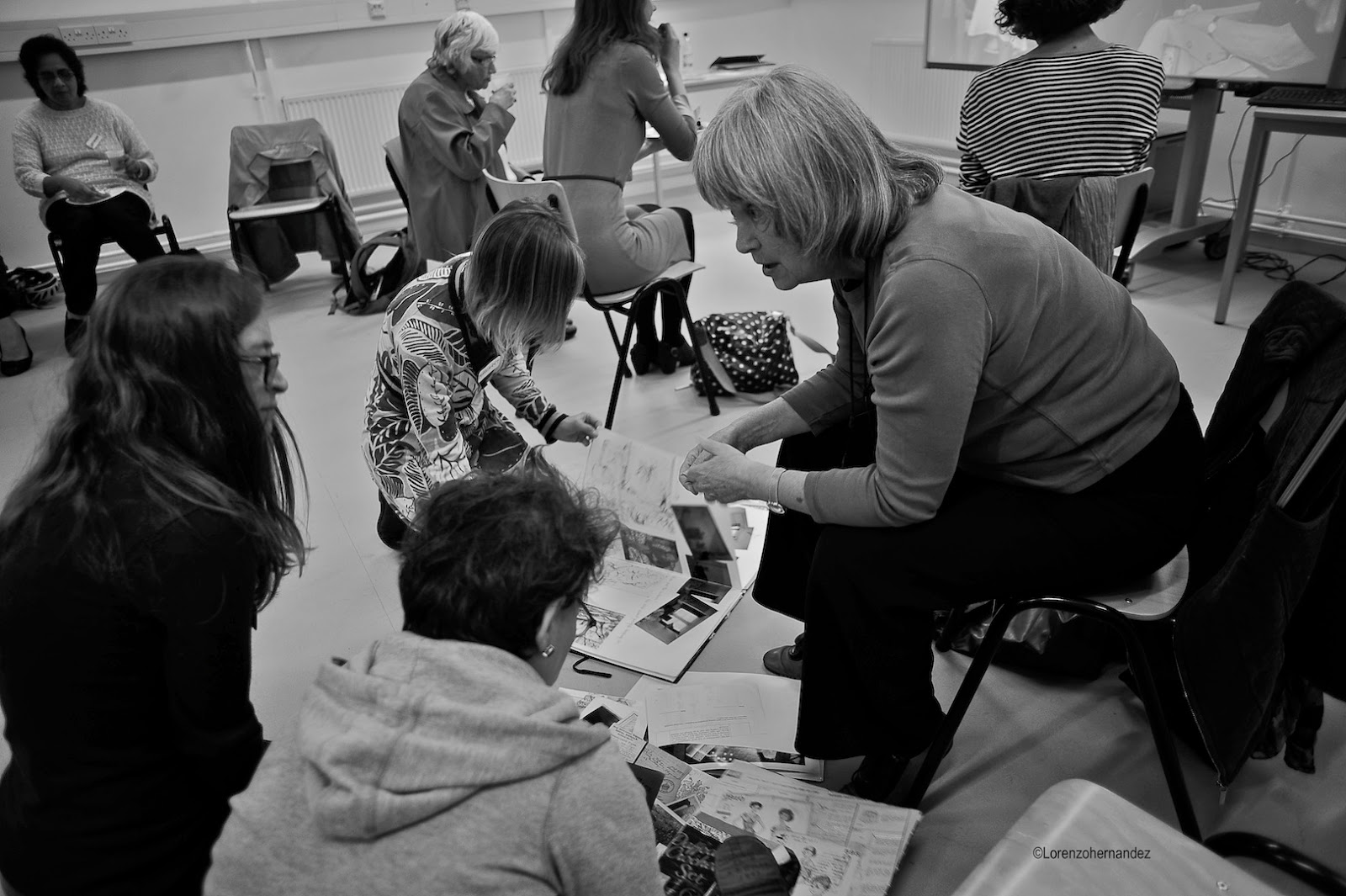
What do we do in these sessions? Basically, we help people to remember and share their memories. Each meeting has a topic: childhood, school, my first job, going out, weddings and relationships, etc. Pam suggests different exercises that facilitate the recovery of these memories.  We never ask them questions; we are just there to listen to what comes to their minds. Being able to remember and seeing how the rest of the participants celebrate what they say gives them confidence, and their relatives confirm that they are more open at home and look forward to the sessions. Also, these meetings give members of the same family or friends the opportunity to do something pleasant and rewarding together.

At the beginning I was also a bit lost. I was afraid of not understanding the people, of not knowing how to relate to them. But they made me feel welcome and at ease from the very first moment. Now I look forward to see them every Monday.

Photos: Lorenzo Hernandez                                            www.photolorenzohernandez.com

Sunday, 3 November 2013

LORENZO'S TIPS FOR LONDON


When people come to London, they tend to do the same things and go to the same places. But there are ways of spending a day in London with a little bit of imagination.
As Lorenzo spends many of his days going to Central London to try to show his portfolio in the fashion magazines, he had done his research and showed Carla and me what to do last weekend. 
First, there are two things you mustn’t forget when you leave your house: the umbrella and the sandwich (there’s no need to go to Macdonald’s). If you use your imagination, you can eat better than in the most fashionable cafe. Go to Sainsbury’s and choose between the delicious three for two bagels and buns, covered in poppy or sunflower seeds. You can fill them with cherry tomatoes (here they taste really sweet), salad, ham and cheddar cheese. Don’t forget to add a bit of oregano and olive oil (we brought a 5 litre bottle from Spain).

Forget about spending the day in the underground. It’s much better to take a double-decker bus. From the one we take, number 53, you can see the London Eye and the River walk. It’s the best way to get to know the city.
There are many interesting art galleries around Central London where you can see the works of the great masters and the newest artists. In the Halcyon  Gallery at 144-146 New Bond Street you can visit the Master Editions: works by Picasso, Dali, Miro, Chagall, Degas, Henry Moore, Warhol, Renoir,  and even Rembrandt; all for sale. And you can walk around freely, not like in certain museums I won’t mention here.

Another interesting exhibition you can see in the same street, at number 134 is the one of Joe Black at the Opera Gallery. This artist reproduces famous photos in big format using different types of materials like toy soldiers (Obama), nuts and bolts (Margaret Thatcher) or badges (Marilyn Monroe). He had sold almost everything in just a couple of days.
And if you are a lover of good photography, we recommend you the Atlas Gallery at 28 Cork Street, near Baker Street.


And if you happen to be in the company of a young lady, like Carla, you can enjoy walking around the trendy shops in New Bond street. She loves Victoria Secret, which is like Woman's Secret taken to the theatre.
You can also find art in the shop windows, as you can see in this photo, taken at Harvey Nichols stores in Knightsbridge. 


At lunchtime you have your choice for parks: Hyde Park, Green Park, St. James Park... and take a seat in one of their comfortable benches. Here you can enjoy watching the people around, their multicultural variety. This time of the year you can also play with the squirrels.


For coffee, you have three places to choose from the tastiest coffee in the city: the Nespresso shops. There’s one near Harrod’s, one near Picadilly Circus and the other in Marble Arch.


And if you want to listen to good music, an interesting option if to watch out for the concerts given by students from music schools. Here the level is really high and it’s a delight to listen to young kids mastering jazz pieces. For  example, last Tuesday Lorenzo and me enjoyed a bit of jazz in Blackheath Great Halls performed by students from the Trinity Laban Conservatoire.
London is being a real source of inspiration for the three of us. 
Photos: Lorenzo Hernandez                                                      www.photolorenzohernandez.com

Sunday, 27 October 2013

ONE NIGHT AT THE THEATRE ARCHIVE


One of my favourite places to work is the Reminiscence Theatre Archive in the Old Baths, Woolwich. As soon as I arrive, Jason, the caretaker, hands me the keys with a big smile on his face. I have to sign in on a register book and then I go up the stairs to my little office. I switch on my computer and I start travelling down memory lane.
Pam Schweitzer donated the Reminiscence Theatre Archive to the Drama Department of the University of Greenwich. This archive contains her work of thirty years. Each box contains all the material related to a single play: photos, flyers, touring schedules, scripts, recordings of the interviews that inspired the play, etc. You can discover all about this archive at www.reminiscencetheatrearchive.org.uk
Last Tuesday I had a visit from Finland! It was Elvira, the lady who had preceded me as an assistant at the ERN. She told me about how much she loved the place, she asked me not to forget to water her dear plant and she told me a bit about the boxes she had been working on until she left. The last one contained all the material related to Can we afford the doctor? This play is based on the testimonies of people who lived in the 1920s and 1930s and who were interviewed in 1985. In those times before the creation of the National Health Service, the first question that many people asked themselves when someone got ill was exactly this one. In a time when the health cuts make the front pages of our newspapers, both in the UK and Spain, this play becomes especially relevant.
Can we afford the doctor? was first performed in 1985. There is a very interesting Channel Four documentary about the making of this play, directed by Pam Schweitzer and performed by the original Age Exchange Company. You can watch it at http://www.reminiscencetheatrearchive.org.uk/page_id__146_path__0p3p.aspx


Today, the Reminiscence Theatre Archive Company  (RTA Co), whose members are drama students at the University of Greenwich, is preparing a new version of this play, directed by Ross Crossby, a very enthusiastice graduate from this university, and Pam herself. Lorenzo and me were lucky to attend one of the rehearsals.

After some warm-up exercises, which everybody joined, including us, Pam asked us to remember a time when we were children and had to go to the doctor. Then, in groups, we had to act up these short sketches. For example, a girl called Jo remembered how she had to be given stitches at the age of ten and her mother nearly fainted at the sight of her blood.


Then the members of the company showed another sketch they had prepared the previous week based on one of the memories gathered in Can we afford the doctor? A girl remembered feeling very ill and being taken to hospital to be put first in an isolation room and then in a ward full of adults who told her to shut up whenever she cried at night. The worst was that she had her hair shaved by the nurses. 


The performance was very well choreographed and we could really feel the atmosphere in the hospital ward. The actors and actresses played different roles each, and moved from one to another skilfully. Still, Pam and Ross made them change some things, which improved the final effect.


Then, Pam divided the company into two groups and gave them the same extract of the original play. It was very interesting to see how different people interpreted the same text.


And finally, we had to practice some of the songs from the play. It was good fun, as some of the names of the remedies were real tongue twisters.


And this was our night at the theatre. It reminded me of the Jumble Sale Theatre Company sessions. It was really good fun. 
Photos: Lorenzo Hernandez www.photolorenzohernandez.com

Sunday, 20 October 2013

TWO WONDERFUL DAYS IN LONDON


Today I would like to have a break from work and tell you about my first free days in London. It all started like a normal working day. I was supposed to work in my computer and wait for Pam to call me, as we had things to discuss about the conference Remembering Yesterday Caring Today, which is going to take place in London in June 2014. I expected to spend the day discussing papers and figures, but Pam suggested that we go to the University of Greenwich, and see the venue where the conference will take place.
It was a wonderful autumn day; the sun was shining and the mild temperature kept our spirits up. We took a walk across Greenwich Park, past the Royal Observatory and the meridian towards the university. Greenwich Park is one of the biggest green spaces in London. It's on a hill and from its top you can see the Royal Naval College and London's new skyline, so different from the one I remembered from twenty years ago, when I studied at the Polytechnic of Central London. Now, apart from the Canary Wharf you can see the new skyscrapers such as Norman Forster's Gherkin, or Renzo Piano's Shard.
As we walked, we discussed how to solve a problem related to the Reminiscence Archive. One of the plays we are cataloguing at the moment, Can we afford the doctor?,  has missing material: the transcripts of thirty interviews with older people about what it was like to be ill in the 1920s and 1930s, before the creation of the National Health Service after the Second World War, have disappeared. Each recording, made in the 1980s, is about one hour long, so you can imagine the amount of work it might entail to transcribe all of them. We needed volunteers, and we wondered where we could find them.
When we arrived at the university I was impressed by the beauty of the buildings, all by Christopher Wren. We entered King Williams Court, one of the buildings, as Pam wanted to show me one of the lecture halls where the conference will take place. We got to the third floor to find out that there was a class in progress in that room. I looked through one of the little windows on the door and saw the professor at the bottom, in front of a powerpoint presentation that read: What is volunteering? Pam opened the door a little bit, and of course, the students next to the door moved their heads towards us. In that moment the professor asked: Has anybody worked as a volunteer? Only five or six arms were raised. We could find some volunteers here _ I whispered to Pam. It's worth giving it a try _she said. In that moment, Pam entered the hall saying out loud: Excuse me for interrupting this class, but I happened to hear that you are talking about volunteering and I am here to offer you the possibility of working as volunteers for the Reminiscence Theatre Archive. She gave such a great performance that we managed to get twenty volunteers!! This is what makes Pam Schweitzer so great.
Later on, Pam took me to the amazing dining hall and chapel of the Royal Naval College and we were so lucky that there was a free harpsichord concert by an amazingly talented Japanese performer. Nothing could improve this day: we had sunshine, art, music, we had found the volunteers... And we almost saw the Duke of Edinburgh renaming an ancient ship that had been brought from Scotland and was going to travel all the way to Australia to be repaired. This time Pam didn't manage to convince the security guards to let us in, but she almost did.
That evening we attended the opening of an exhibition of our friend Phil's paintings.
It was a very lively event, full of family, friends and people interested in his art. In the picture you can see me talking to baby Layla and her dad.
The next day, Lorenzo and me decided to become tourists and took a bus to central London, mixing ourselves with the hundreds of Spanish and Italian tourists who visit the area camera in hand.


We saw the horse guard (with two boys marching behind the soldier, as you can see in the picture), a demonstration in Trafalgar Square against the cast system (notice how the protesters are contained by a white ribbon that is moved by the police as they walk on), and a noisy walk in Covent Garden.


We ended up in Green Park, where we sat on a bench eating our sandwiches and witnessed how an English couple had a monumental row. I thought they were two actors rehearsing but no, it was real. Finally they stormed in opposite directions. Viva el amor.
Sue, our landlady, has lent us a book called Quiet London, a guide to hidden places where you can find tranquility. I think we'll try one of these next weekend.


Photos: Lorenzo Hernandez                                              www.photolorenzohernandez.com